AI Does Not Have a Data Problem. It Has a Meaning Problem.
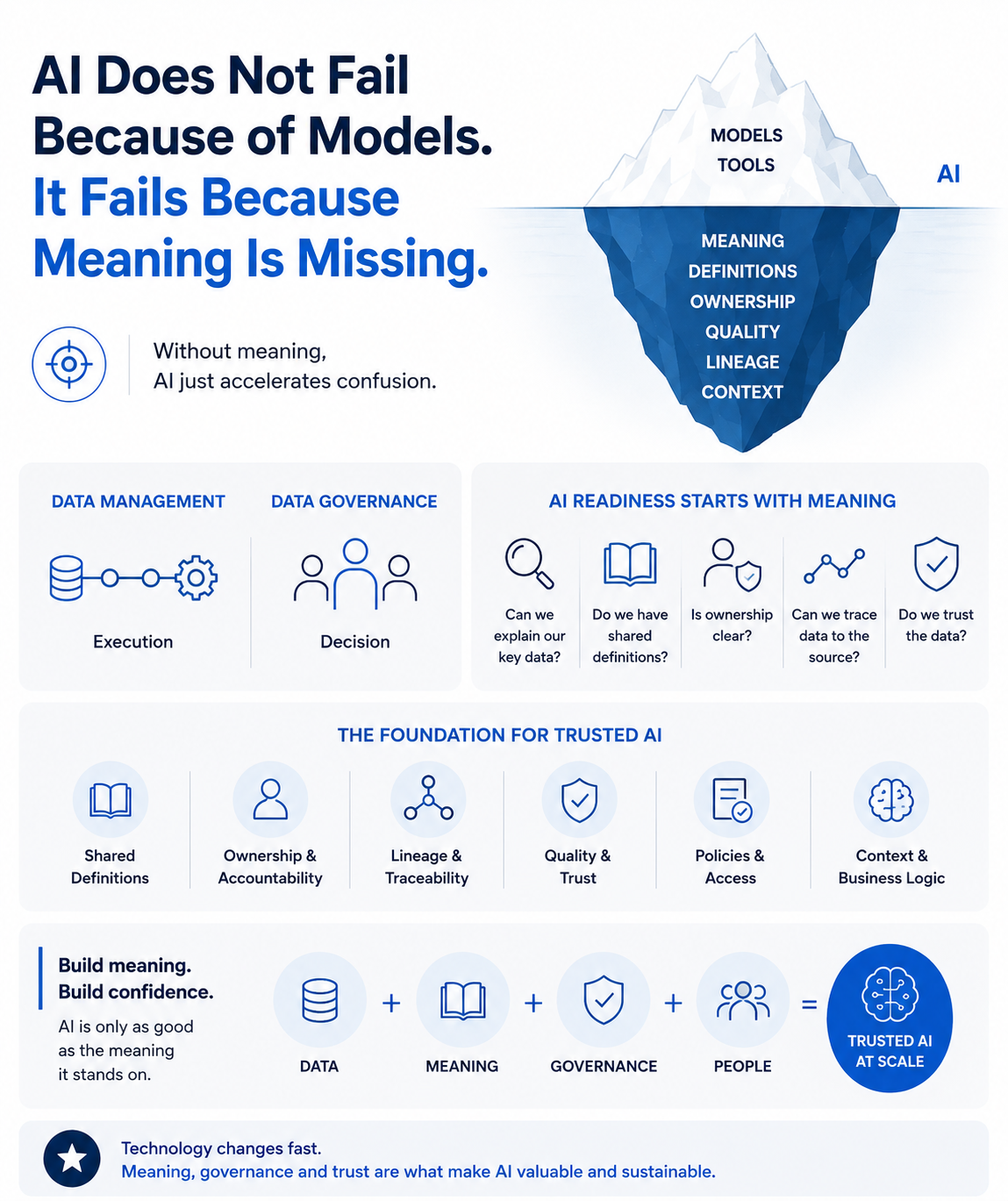
Many organisations are investing heavily in AI. New platforms, copilots, agents, semantic layers, dashboards and data products are appearing everywhere. The ambition is clear: faster decisions, better automation, more intelligent processes and more value from data.
But beneath that ambition sits a more fundamental question.
Do we actually understand what our data means?
For many organisations, the answer is uncomfortable. Critical knowledge still lives in people’s heads. Definitions differ between departments. Ownership is unclear. Data quality is discussed only when something goes wrong. Lineage is incomplete. Metadata is fragmented. And business rules are often hidden in reports, spreadsheets, applications or undocumented workarounds.
In that situation, AI does not solve the problem. It scales it.
AI can generate answers faster, summarise information faster and automate decisions faster. But if the underlying data is ambiguous, inconsistent or poorly governed, speed is not the same as progress. It simply means that confusion travels faster through the organisation.
This is why data management and data governance matter more than ever.
Data management makes data available. It deals with ingestion, integration, storage, transformation, modelling, quality monitoring and delivery. It ensures that data can move through the organisation and be used in systems, reports and analytics.
Data governance gives data meaning and accountability. It defines who owns data, who may decide on definitions, which rules apply, what quality is required, how access is managed and how data is used responsibly.
Both are essential. But they are not the same.
A modern AI strategy needs both the technical ability to manage data and the organisational ability to govern meaning. Without that combination, AI remains fragile. It may work in a proof of concept, but it will struggle when used in real processes, with real users, real risks and real accountability.
This is where semantic layers, knowledge models and data catalogues become strategic.
They are not just documentation tools. They are the connective tissue between business language, data models, policies, lineage, quality rules and AI use cases. They help organisations move from isolated data assets to shared understanding.
A semantic layer answers questions such as: what do we mean by customer, revenue, risk, product, patient, supplier or employee? A knowledge model shows how these concepts relate to each other. A data catalogue makes the connection to actual datasets, systems, owners, rules and usage visible.
Together, they make invisible assumptions visible.
That is also why regulation such as the AI Act and Data Act is relevant beyond legal compliance. These regulations push organisations toward explainability, traceability, accountability and responsible use. But those capabilities cannot be added at the end of an AI project. They must be designed into the data and AI operating model from the start.
The real question for leaders is therefore not: which AI tool should we buy?
The better question is: can we explain the data, meaning, rules and choices behind our AI?
Can we trace the data back to its source?
Can we explain the definition used in a model or dashboard?
Do we know who is accountable for the data?
Can we prove that the data is fit for purpose?
Can we show which policies and access rules apply?
Can we explain why an AI-enabled process produces a certain outcome?
If the answer is no, the organisation may be ready to experiment with AI. But it is not yet ready to scale AI responsibly.
The organisations that will succeed with AI are not necessarily the ones with the biggest budgets or the most advanced models. They are the ones that create clarity first. Clear definitions. Clear ownership. Clear lineage. Clear quality expectations. Clear accountability. Clear links between data, decisions and outcomes.
AI needs more than data.
It needs meaning.
And meaning does not appear automatically. It has to be designed, governed and maintained
