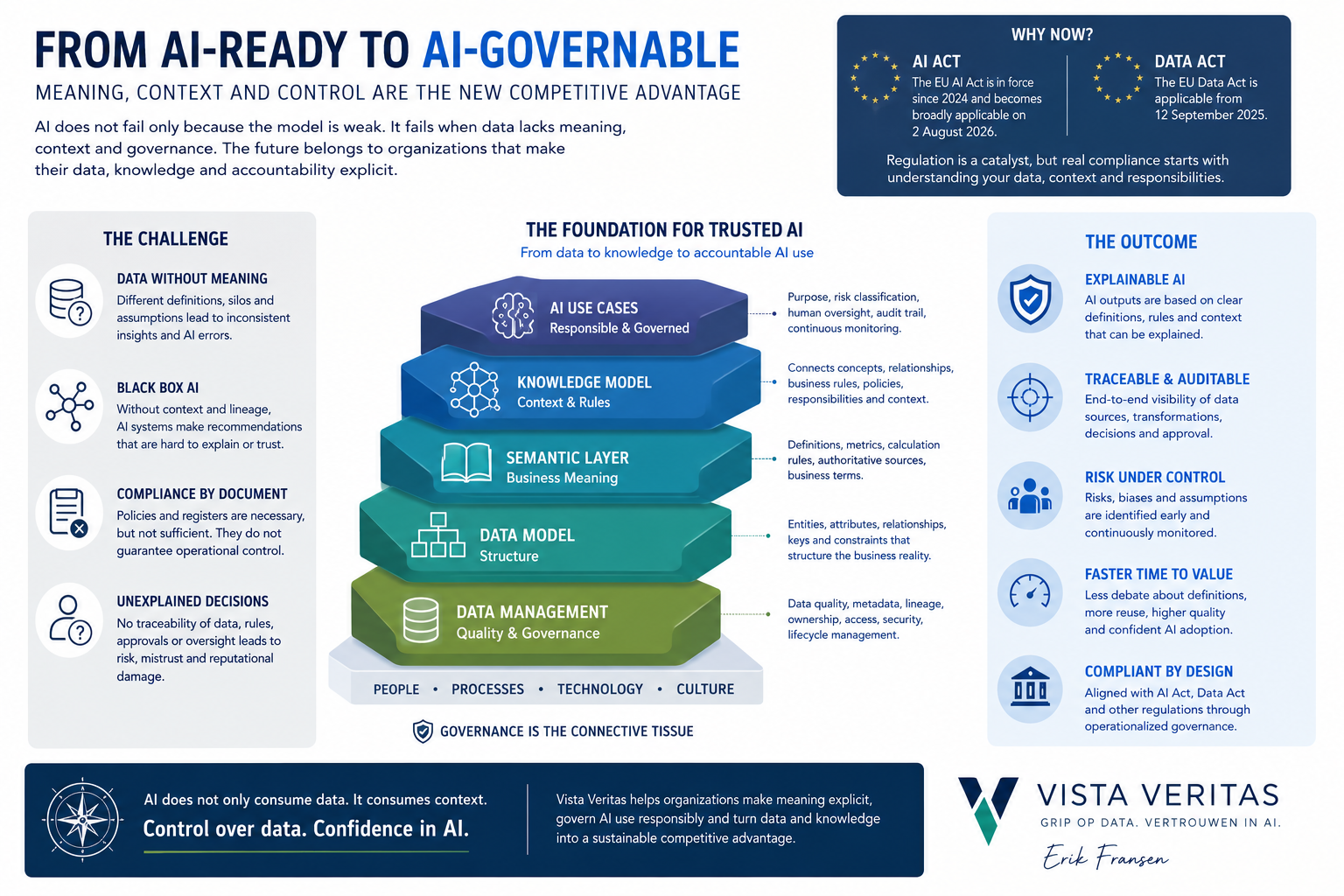
Many organisations are now past the first wave of AI experimentation. They have tested generative AI, built pilots, connected tools to documents, dashboards and databases, and discovered the same uncomfortable truth: AI does not fail only because the model is weak. It often fails because the organisation cannot explain its own data well enough.
That is why the next phase of AI will not be won by organisations with the most tools, the largest models or the most enthusiastic innovation teams. It will be won by organisations that can make their data, definitions, rules, relationships and responsibilities explicit.
In other words: by organisations that can make invisible data visible.
For years, data management has focused on quality, integration, architecture, governance and reporting. All of that remains essential. But AI adds a new pressure point. A human analyst can often compensate for unclear definitions. An experienced data steward knows that “customer”, “client”, “policyholder” and “account” may mean different things in different systems. A business expert understands which numbers can be compared and which cannot.
AI does not automatically understand that context.
If we ask an AI system to generate an answer from poorly described data, it will still generate an answer. That is the risk. It may sound convincing, but it may be based on the wrong definition, the wrong dataset, the wrong relationship or the wrong assumption.
This is where semantic layers, knowledge models and data models become much more than technical artefacts. They become part of the trust infrastructure for AI.
Traditionally, the semantic layer was mainly associated with business intelligence: a way to translate complex technical data structures into business-friendly measures, dimensions and definitions. That remains valuable, but in the AI era the semantic layer becomes broader and more strategic. It is no longer only about reporting consistency. It is about controlled interpretation.
Without a semantic layer, AI is often guessing. With a semantic layer, AI can be guided.
A data model describes structure. A semantic layer describes business meaning. A knowledge model goes one step further: it connects concepts, relationships, rules, policies, responsibilities and context. For AI, that is crucial. It helps explain that a patient is not just a record, but part of a care pathway. It shows that a customer is linked to consent, products, risk profiles and contractual obligations. It makes visible that a data product has an owner, quality rules, lineage and permitted usage. It connects an AI use case to its purpose, risk classification, human oversight requirement and audit trail.
This is where data management and AI governance meet.
The EU AI Act and the EU Data Act make this connection unavoidable. They push organisations toward clearer documentation, risk classification, transparency, access rules, accountability and control. But compliance will not be solved by policy documents alone. The real question is whether governance can be embedded into daily work.
Can we trace which data was used by an AI system? Can we explain the meaning of that data? Can we show who approved the use case? Can we demonstrate that quality, bias, risk and human oversight were considered? Can we prove that the system is used within its intended purpose?
If the answer depends on manual reconstruction, scattered spreadsheets and undocumented expert knowledge, the organisation is not AI-governable. It may have AI ambition. It may even have AI capability. But it does not yet have AI control.
This is why data management is moving back to the strategic centre. Not as bureaucracy, not as a theoretical framework, and not as a set of roles on paper, but as the operating system for trusted AI.
Data governance defines ownership and decision rights. Metadata management makes meaning and lineage visible. Data quality management creates confidence in inputs and outputs. Data modelling structures the business reality. Semantic layers translate that reality into usable meaning. Knowledge models connect meaning to rules, responsibilities and context.
Together, these disciplines create the foundation for AI that can be used, explained, challenged and improved.
Many organisations are now working with data products. That is a good development. It creates ownership, reusability and clearer accountability. But the next step is the knowledge product. A knowledge product does not only provide data. It provides meaning, relationships, lineage, quality indicators, usage constraints, business rules, regulatory context and ownership.
That is the kind of asset AI systems need. Because AI does not only consume data. AI consumes context.
For me, this is exactly where the future of data and AI is heading. We should stop treating AI as something separate from data management. And we should stop treating data governance as a compliance layer that slows innovation down.
Good governance accelerates AI. It reduces uncertainty, prevents endless debates about definitions, makes risks visible earlier and gives professionals the confidence to use AI responsibly. It helps leaders move from experimentation to controlled value creation.
That is the core of Vista Veritas:
Control over data. Confidence in AI.
The organisations that succeed with AI will not be the ones that simply adopt the newest technology fastest. They will be the ones that understand their data, model their knowledge, govern their use cases and make accountability operational.
AI-ready was the first step. AI-governable is the next one.
And that journey starts with making meaning explicit.
